The sales funnel is a strategy that seeks to represent the steps by which a consumer goes to carry out the purchase of a product or service. Thus, it helps guide marketing and sales teams to act in the most appropriate way with each customer, depending on the phase they are in. But what's the difference between a regular sales funnel and the Y funnel? That's what you're going to read in this article!
This is an ideal methodology for clearer communication and also for developing assertive strategies in each scenario, especially for the moment we are living. The concept of Y Sales Funnel is not new, although it is not so well known among professionals and companies.
Contents
Toggle- What is a Y-selling funnel
- Understanding Inbound and Outbound practices
- How the sales funnel works in Y
- Benefits of Y-selling funnel:
- Good practices for the efficiency of the Y funnel
- Conclusion
In a nutshell, the Y Sales Funnel represents the stages of your customer's Purchase Day, and at each stage presents the maturity and qualification levels of each lead, as well as what activities will be performed by the marketing or sales teams.
This methodology is ideal for leveraging lead generation, helping in brand positioning, improving financial results, among other positive points.
With the Y-selling funnel you can train your team by showing the details of each stage of the sales process, as well as having easier management and optimization, allowing everything being done to be visible to managers.
It was named after the name because it has a format similar to the letter Y, due to the segmentation at the top of the funnel between Inbound and Outbound.
See also:
- Growing up without losing financial control: Prosperittas reinforces its role as a strategic partner of companies
- WaveMaster AI closes 192 spots in Brazil by integrating 20 monitored beaches and over 800 beaches on 6 continents
- Shopping H de Blumenau wins new institutional website developed by NVX
- Spectrochem Opens New Institutional Site with Focus on Innovation and Digital Presence
- Gastronomy and Culture: A Meeting That Transcends Tastes
- How digital agencies can organize and protect customer accesses with a professional password manager
- Forget the “123456”: How a Password Manager Can Simplify Your Digital Life (and Avoid Head Pain)
- ACATS launches new site with modern design and intuitive navigation, developed by NVX – NationalVOX
- 8 Infallible Tips for Mastering Google Search in 2025
- Passwords Guard extends its mission to protect Brazilian companies with secure access and password management
Understanding Inbound and Outbound practices
Before I go further into the sales funnel in Y it is necessary to remember the practices of Inbound and Outbound.
- Inbound
Inbound Marketing starts with the attraction of potential customers through content strategies, so that this is possible it is necessary to understand who the consumer is. Then comes the conversion, which has landing pages and site forms as allies; its main goal is to get as much information about the client as possible in exchange for relevant content.
Finally, we have the nutrition phase, which begins when the lead accepts the exchange relationship, but is not ready for a real purchase. After the capture, it is necessary to nourish it to stimulate its interest in the brand presented, qualifying it as niche, market and advantages.
Inbound= Attraction + Conversion + Nutrition to Qualification
- Outbound
Outbound Marketing, on the other hand, starts with active lead capture, also known as active prospecting, using digital tools and communication channels. In the connection stage, attempts to contact the captured lead are initiated, using cadence flows.
Finally comes the last step. The team separates qualified leads from those that are not yet, it is worth remembering that it is necessary to understand their needs, pains and objections to work on them over time.
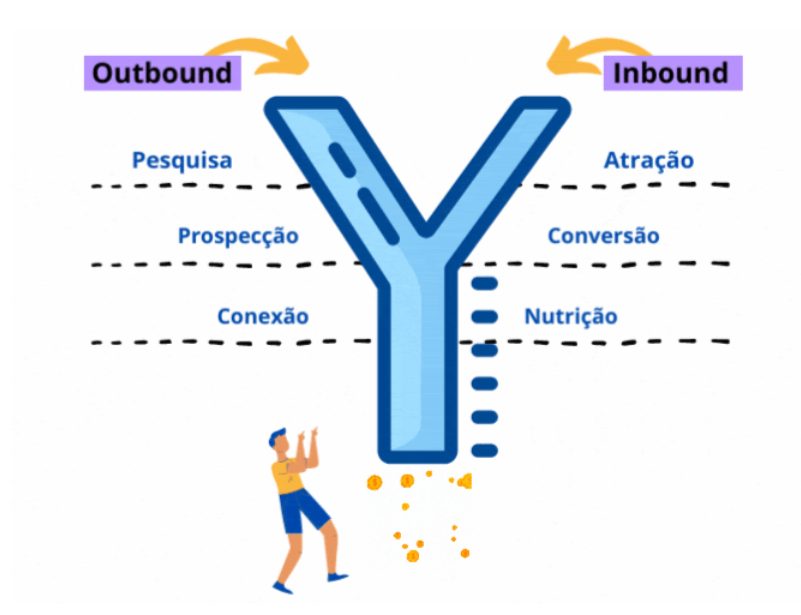
Now that you remember what Inbound and Outbound are like in practice, it's time to learn how the Y-selling funnel works, which creates bridges between the two methodologies. Is that innovative or not?
Both Inbound and Outbound have different ways of capturing and nourishing their customers, where bridges help integrate these steps according to the maturity level of each lead. In a short way, there are three essential bridges to generate leads and increase your revenue:
- Convert and Connect: This is the case of leads that have been attracted by rich material and have a good level of qualification, but have not shown interest in the new content sent. It's time to transfer it from the inbound to the outbound, so the sales team can contact you.
- Connect and Nutrition: If connected leads are not aware of the solution or are not yet financially prepared, this is the time to transfer them to Inbound, this team will be responsible for feeding them information relevant to their evolution in the purchase journey.
- Nutrition and Qualify: This is the bridge to the leads that are nourished and have gone through the whole journey, but have not requested budget. Now it's time to contact us to see if there's any interest in closing the purchase.
1. Marketing and sales working together
One of the biggest problems companies face is the lack of alignment between marketing and sales teams. The Y-selling funnel comes as a solution to this situation, where teams can work from shared strategies, balancing efforts and meeting market needs and especially from prospect or client.
The main objective is to bring teams closer together to leverage lead generation as well as company results. To do so, both teams must join strategies and work together in search of the same goals.
2. Integration between strategies
Currently it no longer makes sense for the same company or commercial team to work so differently the leads generated from different strategies.
In many situations we see different processes and even pricing and trading conditions (which can be harmful to business).
By uniting the models into a single management and monitoring tool, it is possible to monitor the results in a broader way and to trace actions that consider the evolution of leads in the purchasing process in a more optimized way.
3. Taking advantage of Outbound leads
We have seen before that one of the possible integrations allowed by the Y sales funnel is to migrate its Outbound prospects to Inbound nutrition flows.
Thus, we avoid the waste of leads raised and addressed proactively, but that were not at the perfect time for the acquisition.
From the moment this base of contacts or prospects passes to the nutrition flows via Inbound, it already has an important qualification: they are within the ideal customer profile, with a higher probability of conversion and closing business.
4. Lead acceleration Inbound
Following the inverse and natural path of the marketing process, Inbound leads can also migrate to Outbound's actions, moving the funnel.
This happens when the commercial team looks for leads for approach within the company's own Inbound base, from the analysis of interaction, lead history or profile raised from the forms.
This careful analysis, usually done more accurately by the sales team over contacts that already have ideal customer characteristics, allows them to be addressed weeks or months before what is expected, within the nutrition flows, accelerating the results and ensuring greater assertiveness for the commercial team.
Good practices for the efficiency of the Y funnelConstantly analyzing the metrics
Remember that sales metrics need to be at the focus of commercial management always and even more, when two lead generation and management models are combined to search for the best results.
By integrating the shares, be sure to monitor whether factors such as CAC (customer acquisition cost) and LTV (Lifetime Value) really improve or whether it is just the volume of new customers that increases. Marketing experts confirm that these two metrics talk a lot about the quality of closed business and often can import more than volume.
Optimization of sales team
When you start working on the Y funnel, the sales team's effort should also be optimized. For this, the training of sellers is essential, with the aim of helping them to understand the right moment to migrate a lead from one model to another. This involves a closer approximation of marketing and even access to leads, with all the updated information.
It is quite recommended to follow up on how much the transition from a traditional sales funnel to a Y funnel actually means less effort to get to the closing, which will help in team management and its division by functions or activities. It is worth saying that teamwork, creating efforts, makes all the difference for the methodology to work.
ConclusionAlthough it may seem complicated for those who are not very used to marketing, understanding how the Y funnel works is quite simple and, when put into practice, its results are undeniable. To know when a lead is ready to be used in the methodology, seek to analyze and understand above all his interest, profile and maturity.
With this process well aligned, several stages and features arise for both teams, creating shared purposes and strategies. After all, to consolidate a good strategy, we need to think of all fronts.
Among the numerous content recommendations that make up this article, try reading this article: what is sales funnel and why you need to have one!
What then, prepared to put your funnel in Y? If you need help, count on the Nationalvox Digital Agency team.