
The main goal of those who have a business is to sell their products and services, right? But after you're already selling, the concern should be to improve and optimize the results.
One of the ways is by applying the call A/B test, which is exactly one of the advantages of digital marketing. With it we can understand what works, to repeat in the future, and what does not work, seeking to find improvement points.
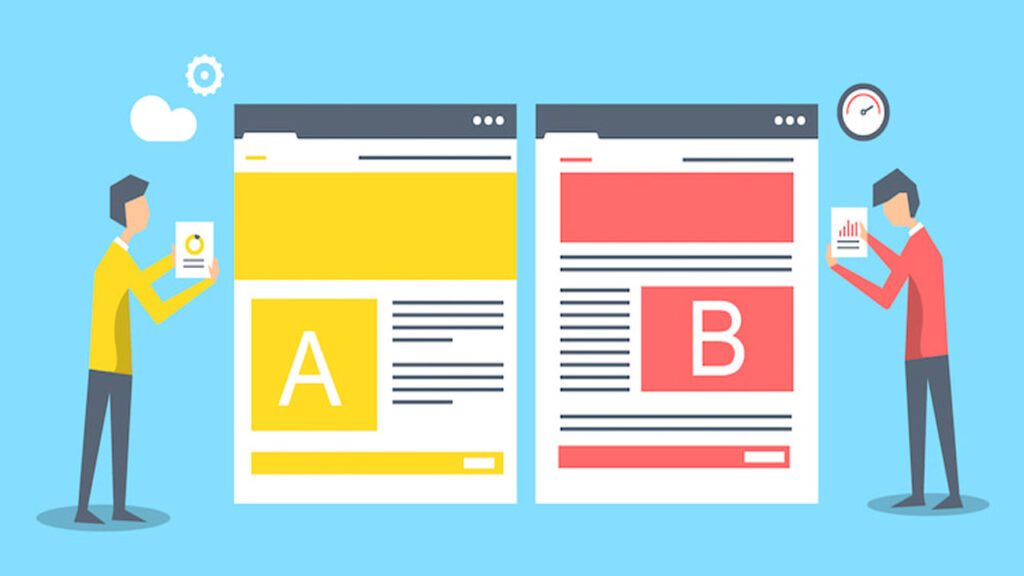
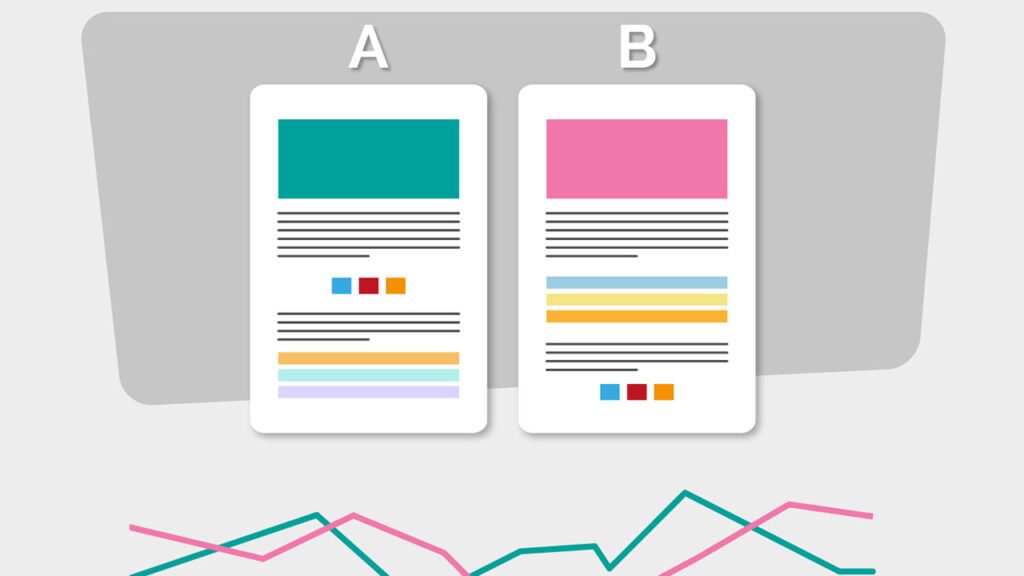
It is the process of comparing two versions of a destination page, email, Facebook advertising campaign or other marketing assets with just one different element.
For example, if you are testing A/B on a call to action button (CTA), you need to create two versions of the same target page, but only call to action will be changed.
This type of test can be valuable to a company because it costs nothing (only planning and implementation of the strategy) and saves money.
Read also
- 8 Infallible Tips for Mastering Google Search in 2025
- Social media trends for 2024: platforms that are shaping digital marketing
- The Power of Google Evaluations: How to Improve Your Business’s Reputation
- The new era of email marketing: how to stand out in the inbox
- CRM for real estate and construction companies: boosting sales and loyalty to customers
Contents
Toggle- Check out in which cases the A/B test can be efficient:
- Benefits of the A/B test
- What to test:
- Google Optimize
- Conclusion
Check out in which cases the A/B test can be efficient:
Bringing more traffic to the site: testing different blog posts or web page titles can change the number of people who click on the hyperlink title to access the site. This can increase page traffic as a result.
Achieve better conversion rate: test different locations, colors or even anchor text in your CTAs can change the number of people who click on these buttons to access a destination page. This can increase the number of people who fill out forms on your site, send contact information to you and end up converting, turning leads.
Have a smaller one rejection rate: if visitors to your site leave (or “reject”) quickly the pages after visiting the site, testing different content, fonts, images, graphics or animations may reduce this rejection rate and retain more visitors.
Drop out of cart: Companies working with ecommerce lose about 40% to 75% of visitors, leaving the site with items in the shopping cart, according to studies.
This is known as “shopping cart abandon”. Testing different product photos, check-out page designs and how far shipping costs are displayed can reduce this dropout rate.
Benefits of the A/B test
Better user involvement
Elements of a page, application, ad or email that can be tested in A/B include the title or subject line, images, call to action forms (CTA) and language, layout, fonts and colors, among others.
Testing one change at a time will show which affected the behavior of users and which did not. Upgrading experience with “winner” changes can improve the aggregated user experience by optimizing it for success.
Higher conversion values
A/B test learning successfully applied to an experience can be used in additional experiences, including product pages and services with higher prices. Better involvement in these pages will demonstrate similar elevations in conversions.
Here on NVXwe use the test to understand which email subjects sent in customer campaigns, had the best opening rates. Or which landing page model generated more conversions in attracting new leads.
Ease of analysis
The determination of a winner and a loser of an A/B test is direct: which page or application metrics approach their goals (time spent, conversions etc).
Not long ago, the A/B test metrics were just raw numbers (data) and you would have to interpret them manually to make a decision. Now, many marketing tools available in the market, already offer various types of tests (the email subject is the most common one) and make decisions for you with statistical mechanisms following recommended practices.
And although test services have evolved to include statistical analysis for users of all levels of knowledge on spreadsheets or dashboards, the numbers for a comparison of two experiences are surprising in their complexity.
Everything can be tested
Forms, images and text are traditional items for testing and updating A/B, but any element of a page or application can be adjusted and tested. The title style, the colors of the CTA buttons, the size of the form for example, may affect user involvement and the conversion rates in ways that may never be known if they are not tested.
No idea can be rejected when thinking about optimizing results; tests and metrics, not emotions, prove what works and what doesn't work.
Risks are reduced
With the A/B tests, it is possible to avoid commitments with costly and time-consuming changes that are proven to be ineffective. The main decisions can be well informed, avoiding errors that, otherwise, could link resources to minimum or negative gain.
The most common way to perform the A/B test is to use it to rule something out. If you realize that making a change can slow down conversions, don't go forward.
Sales increase
Any and all of the A/B test benefits mentioned above serve to increase sales volume. Optimised changes produced by the tests offer best user experiences that, in turn, generate trust in the brand, creating loyal customers and therefore increasing or maintaining the sales targets.
What to test:
Before you start taking the A/B test follow the tip: it is not recommended to test more than one element at a time, since in some situations it may be impossible to know which change was responsible for the results.
In general, the items that most often change the conversion results of a page or website are:
- Headline – the title that is highlighted on the page
- Call-to-Action (convert button)
- Images or videos
- Description of any offer
- Form size and fields
- Reliability indicators (witnesses, certificates etc.)
Avoiding common errors
If you've come this far in reading the post, you already know that conducting tests is one of the most valuable advices of marketing experts, which cannot be ignored. But it's necessary Be careful with some details.
The main one is the need for a good volume of accesses (quantity) to validate the test. If you still have a small lead base to test A/B by email, or visits to your site are very low, it doesn't make sense.
Although they have case studies that show improvements in conversions as if they were simple, it is difficult to find variables that will really make a difference in numbers.
A situation that often happens: experiments that fail, where the difference between one conversion and another is not relevant, should be reported.
How do you know when to stop testing?
One question you may be asking yourself right now is “how often should these tests be done”? The answer is: do as many times as it takes to get to know your audience and ensure more and more conversions.
The test is important for companies, especially because the user does not know that he is part of an experiment, so everything will happen normally.
The amount of tests varies according to the needs of your business, as well as understanding the time to stop testing.
It's worth noting that everything is relative. When we talk about calls to a blog post, for example, the A/B test may last longer, since this offer has no validity period.
The same is indicated for email marketing: if it is the subject A/B test, for example, it is essential to have patience and start measuring after a period of at least seven days, giving enough time for the base to contact the received email.
But the scenario can change when we focus on online stores. In ecommerce, care must be taken, because very long tests also mean very long cycles, and most of the time the error at the time of conversion is there. Keep your eyes open!
Google Optimize
There are many tools (software) in the market to perform A/B tests. Most are paid and depend on the subscription of a monthly or annual plan. So I decided to suggest one that's free and belongs to Google.
Google Optimizetook on the test functions that were before within Google Analytics.
Offers A/B and A/Bn tests you can test multiple versions of the same web page to find out which option is most successful with your users. Multivariable tests, redirection tests, server experiments and personalization, among others.
Conclusion
Take advantage of the tips and start testing your web actions today, to maintain or increase sales and smart form, using data and metrics efficiently.
The A/B test is not complicated, but you need to have a marketing strategy and a goal before you start.
If you still have questions about it, leave a comment below orTalk to me. to apply the strategy professionally on your site. Keep up with our blog, we are always publishing tips to promote your business on the internet.