A challenge that every company or professional who applies the inbound marketing for sales you must face:
- How do you turn site visitors into leads and later into customers?
If you thought about delivering organic and value content to potential buyers of your product or service, using varied channels, shopping journey strategies with email automation, right!
Having an aligned marketing funnel where the steps take place in practice (attraction/enterment of visitors, conversions to leads, opportunities and sales) is critical for any planning that aims to achieve the best metrics and results.
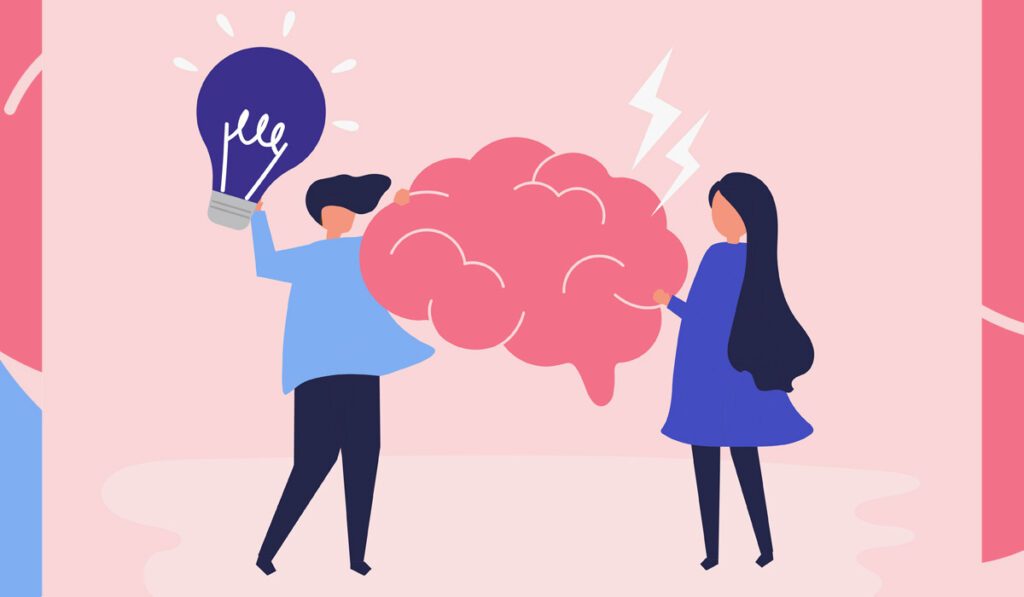
But beyond the techniques and methodologies, the key to success in any business is understanding sales psychology.
All humans have essentially the same mental triggers that drive actions. To influence and understand interested and customers, you need to know what these triggers are and how to use them in the best way in your marketing message.
How do mental triggers work?
Our brain performs a constant selection of things that require more or less attention. The more you dominate a subject, the more automatic and fast is the thought and reaction about it. If the feeling is insecurity, you start thinking more cautiously.
If a company makes use of mental triggers, you, as a client, react more quickly to these stimuli. Why? When your brain accesses information like “take advantage that it’s only today” or “last chance to get your discount”, for example, it goes into alertness, feeling that it may miss an important opportunity.
Understanding how mental triggers work is paramount so that you can use them to your advantage in marketing and sales, working with aspects that may not even the person (in case the potential customer) knows, that influence the decision.
I've selected the main mental triggers your company can use to boost the desired actions (i.e. conversions) between your target audience.
Reciprocity
Reciprocity is a powerful and deeply rooted mental trigger. Actually, it's inevitable. And the principle is simple: when you receive, it is more likely that you give.
It is one of the most widespread and basic norms of human culture and is incorporated into the rule of reciprocity. The rule requires that one person try to repay, in kind, what another person has provided.
Traditional trade has been relying on reciprocity for hundreds of years. Actually, we've all tried that trigger before. Remember the brand tastings at supermarkets, especially in the launch of products. Who's never...
After all, how do you stimulate online reciprocity?
The most obvious way is through what we usually call “digital bait” or “content offerings” By offering your audience a free but genuinely valuable e-mail series, online course, webinar, white paper, checklist or special report, they are much more likely to take the next step in the sales process when it is presented.
Sometimes it's easier to sell when people try the product or solution before they buy. That's why some streaming services give way to a free trial period before you start charging for use. A month, seven days, no matter what, what's worth here is to let a little taste of want more on the possible customers.
Shortage
The harder it is to achieve something, the more scarce an appeal seems or more urgent its appeal, the more we want it. In short, that is scarcity.
In academic terms, scarcity is “the fundamental economic problem of having seemingly limitless human needs in a world of limited resources. He says that society does not have enough productive resources to meet all human desires and needs.”
What drives scarcity is fear. More specifically, as humans, we are much more motivated by fear of losing than by the desire to win. With at least 56% of us experiencing the FLOOR active, this trigger directs consumer behavior and is even responsible for our addictive love borderline social networks.
Why?
Because we want what we can't have. The complicated thing is... how can you create scarcity without waiting for the hand of fate to sway in your way?
Who sells infoproducts (mainly online classes and courses) knows the efficiency of this mental trigger to stimulate buyers. One of the most common strategies is the opening and closing of carts, offering limited-time sales and offering also limited vacancies.
Authority
Considered one of the most frightening mental triggers, people not only respond to legitimate authority but also respond to its appearance. A clear example is how health care companies, supplements or weight loss use endorsements from medical professionals with impressive credentials.
Often digital celebrities or influencers are used for the same purpose. Using Instagram Stories to sell products in profiles that have thousands of followers or can talk to the target audience is one of the most common examples.
Another tip that's much more in mind than hiring a famous guy is to have a blog.
Through it, you can work on content marketing and generate credibility and authority that you need to make people trust you. In other words, you need to master the topics you will address on the blog until it becomes a reference in your area.
That's what we do on Nvx: we feed weekly theAgency Blog (Contents), with topics focused on digital marketing, online sales and internet that really make sense to our readers, possible and current customers.
Important: The mental trigger of authority works beyond the transfer of authority of other people, but also quoting the name of resumes, achievements and expressive numbers that you can obtain.
Social Proof
It's not a very ideal example to use in pandemic and lockdown times, but imagine if you're one of those people who always see a crowded restaurant, I thought, "I should try this place." That is the principle of social proof in action.
It's our tendency to like things or products that other people already like, whether we know them or not.
Does social proof really work? According to a study by Nielsen, 83% of consumers rely on product recommendations from their friends and family. So... yeah, social proof works.
There are some ways to use the principle of social proof to increase online sales.
See also:
- Gastronomy and Culture: A Meeting That Transcends Tastes
- Nationalvox is honored by ALESC for its 20 years of innovation in digital marketing
- NVX 20 years: A history of innovation, partnership and success in digital
- Digital Transformation in Cuiabá Companies: Benefits and Challenges
- Social media trends for 2024: platforms that are shaping digital marketing
- The Power of Google Evaluations: How to Improve Your Business’s Reputation
- 7 content to convert to funnel fund with real estate marketing
You can use analytics, testimonials, social media feeds and user-generated content to turn your customers into brand advocates. By showing real people who love and use your products, you are allowing other customers to know that your products have been guaranteed – and that there are many satisfied customers using your products.
It is particularly effective to use photos and videos, as they allow customers to build a view of themselves using products in these ways.
Trust
Let us assume from the popular principle that “confidence is not imposed, if conquered”.
This mental trigger can be constructed in various ways: through authority, generation of value, social proof, among other possibilities. The goal is to show the customer that he can and should trust his service or product, whether because other people have already proven his efficiency, that is because you dominate the subject.
Trust is triggered when the customer feels he can trust you. Even if there is a problem in providing the service or product, you need to be there to guide it, solve the problem and support it. A mechanism that should have as its priority the relationship.
Urgency
FOMO, or fear of losing, is a strong motivator to get people to do things they would normally experience. Use it on sales, suggesting you can't get it soon, and you better hurry. It's very rare to find someone who never wanted something that he couldn't have.
Create a time impression. Marketing teams often use the phrase “for a limited time” in their campaigns. This language tells interested parties to put aside doubts about how to make a purchase: customers are told that if you don't move now, you won't have the option anymore.
Set a deadline to rush your audience into a purchase. Many supermarkets and many delivery apps use this strategy with great success.
Pleasure.
In most psychological models, humans are believed to act according to the “principle of pleasure.” This trigger is the driving force that forces humans to satisfy their needs, desires and desires. Needs, desires and impulses that can be as basic as the obligation to breathe, eat or drink.
But they can be as complex as the need to buy a specific commodity or service. When we do not get satisfaction, our psychological response is anxiety or tension.
Technology has made us faster. Instant gratification is not just a wish, but something expected in many circumstances; we get real-time feedback from the applications we use, messages can be sent and received in seconds and we can work at the same time a better delivery.
Conclusion
Consider psychology a crucial part of marketing. The “triggers” that can impact your audience more are valuable and deserve to be exploited.
Here I highlighted the main ones, but there are many others. And that requires careful execution planning. But if you can get it right, you can increase sales.
See you in the next article!