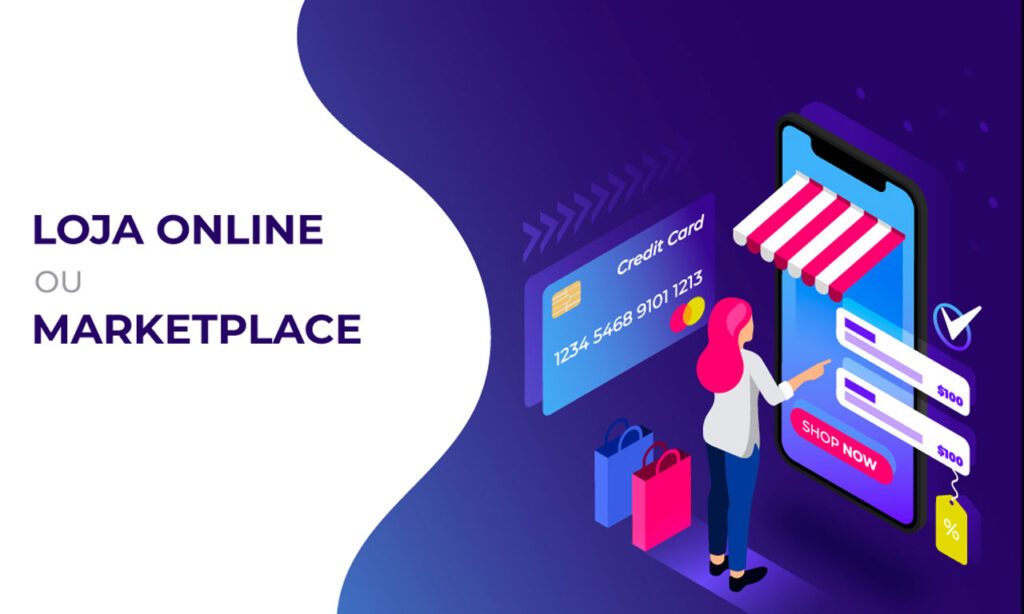
If you intend to invest in e-commerce (online sales), it is quite possible that you may be confused between an online store and a website of several vendors, known technically as Marketplace.
A lot of people think they're the same. But although they still have the same goal, which is e-commerce, a platform (or portal) where several suppliers meet is quite different from an online store.
The online stores appeared in Brazil in 1995When the internet began to be used for purposes other than communication. The marketplace model started a few years later, when people started to depend more and more on online shopping.
Read also
- Learn what D2C is: the strategy that is redefining ecommerce
- Best practices for digital security on websites
- Does organic reach still make sense in digital marketing?
- Key tips to succeed in e-commerce in 2024
- What territorial marketing is and how to do
The term “online” is very generic. There seem to be numerous electronic commerce options, with new businesses being born every day. Choosing the best selling alternative can be a challenging task, especially with competition that never stops growing.
It is good to remember that with the acceleration of market changes, consumer behavior has also become increasingly digital. In Brazil, in recent years e-commerce has already registered good growth numbers.
However, due to the social isolation caused by the coronavirus pandemic, there was a greater growth than expected than new consumers buying through virtual stores.
The need to survive or keep business running, has caused many companies to bet on online retail as a new sales option.
- But where to begin?
- Which channel is best suited to sell online?
In this article, I will show the difference between virtual store and marketplace, and how your business can be enhanced through these two modalities.
How an online store works
This is a sales channel allocated on a website of its own, usually using a e-commerce platform (there are numerous in the market), to perform the most appropriate business management, to have more control and increase profitability.
In this model, only the store's product catalogue is marketed on the website and the shopkeeper (owner) is responsible for all strategies involving e-commerce: logistics, information security, anti-fraud, marketing actions, payment methods, customer relationship and support.
Although it is a bit laborious to maintain such a structure, it ends up being an exclusive space of the virtual store and with autonomy in all areas.
Having a virtual shop of your own allows entrepreneurs more freedom to build the brand in the long term and also direct relationship with consumers, as there is no intermediary in the transaction.
In addition, the biggest concern for those who open an online store is the number of accesses, that is, the generation of traffic.
Creating a virtual store from scratch requires time and a good investment, because in this case, it is necessary to develop the entire infrastructure.
Some specific services are outsourced, such as website developers, database servers, payment gateways, anti-fraud system, among others.
Try to opt for a platform with virtual store ready models. In this case, the time and development investment are much smaller, since the structure is already ready, just setting up correctly to start selling.
Advantages
- Greater autonomy;
- freedom of business decisions;
- Personalization and construction of the brand according to its objective and target audience;
- The sales channel with the highest potential;
- Marketing's own direction.
Disadvantages
- High initial investment if you choose to start from scratch;
- the need for investment in marketing;
- Difficulty bringing visitors' traffic.
How marketplace works
It is a business model where the seller uses the space of another store that is already consolidated, functioning as a showcase for e-commerce.
On these platforms, the products are traded side by side with goods from other sellers, and a fee is paid to the marketplace for each item sold. Generally marketing, customer capture, security and logistics strategies are partner's responsibilities or carried out together.
Think of the marketplace as a big mall, only on the Internet. In this type of platform, thousands of companies are available, i.e. several virtual stores, such as the Free Market, Amazon, among others.
Thus, the consumer gains time and convenience by searching for different brands and prices in the same place.
This is an e-commerce channel in which a large corporation makes available space with all the necessary structure for online entrepreneurs to sell their products. As the marketplace gains from the sales made by the brands, it is it that invests in traffic and marketing to attract consumers.
Advantages
- Work in partnership with large market players;
- High visitor traffic;
- greater visibility;
- infrastructure ready for sale;
- Sharing costs with logistics, payment, financial reconciliation and anti-fraud;
- Low cost with marketing;
- well-established recommendation system;
- High level of reliability.
Disadvantages
- Limited customization infrastructure for your brand;
- Dependency;
- High internal competition;
- High administrative fees;
- Often the brand is “hidden” behind other more famous ones.
Marking and Reputation
Depending on what you are selling, it can sometimes be beneficial to include your product in the midst of a large amount of other products. Perhaps they are complementary products and can make buyers spend more than they would actually spend.
To give an example, if you are selling batteries, it might be good to sell them side by side with a product that uses these batteries, such as automotive equipment, for example. If you sell phone accessories, you want to offer them in a place where people come to buy phones.
However, if you think your products are unique and the fact that they are sold together with other similar products can harm your sales or reputation, it is best to sell them through an online store.
This type of website will help you boost the identity of your brand and your brand. internet reach, as it can attract more traffic than a simple presentation of your business.
You will be personally responsible for your customer's satisfaction in terms of payments, delivery and performance. This means that if you take this seriously, you can promote your brand in a way you would never do in a marketplace.
Marketing and traffic
After having your products offered at the marketplace, you have nothing to do with your promotion. The platform owner is interested in selling as much as he can and this also includes his offer.
Big players like the American, do enough marketing to attract as many customers as possible to the portal. The traffic rate they have is something you probably won't be able to reach months after starting your e-commerce site.
The disadvantage of this is that these will not be your customers and not all the traffic that marketplace attracts will appear in your sales.
You will not have the most detailed customer data and how it can be addressed strategically. That leaves him without leads and no direct relationship with the client.
However, if you are the one who manages all sales and handles customer details, you will have many happy leads and customers to include in your future campaigns.
Speaking of marketing campaigns, you can design and conduct them in any way you think is appropriate if you choose to create an e-commerce.
Conclusion
You had a chance to understand that both sales approaches have their pros and cons. Maybe you can use both alternatives to test the results and decide which one is more worth it.
If you have something to sell on the Internet, don't hesitate: invest in a virtual store and promote your brand to attract interested and customers.
The identity of the brand It's gonna help your company survive and fight the competition. Also, use the fact that a marketplace has less costs involved and is less attractive to have your products visible and available to a larger number of customers.
You want to open your shop online, but you don't know how?
Count on Nvox. 15 years ago we created websites of the most diverse formats and business models, including e-commerce. Talk to me here!
Until the next post!