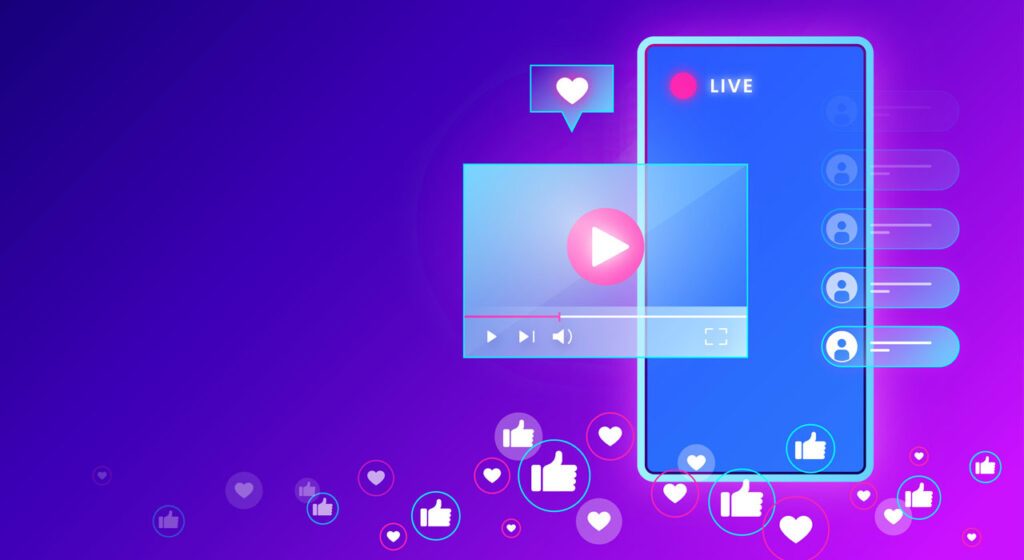
It's already 2021, the pandemic is still between us (we don't know when it's going to end) and lives have consolidated as one of the main strategies in digital marketing to attract audiences, customers and promote brands/people.
The streaming's a big deal. When people realized they could follow events without leaving home, companies had an incredible increase in access.
A scenario that creates opportunities for brands and services: use live streaming tools to provide exceptional experiences and maintain the interest of your target audience.
See also
- Gastronomy and Culture: A Meeting That Transcends Tastes
- Nationalvox is honored by ALESC for its 20 years of innovation in digital marketing
- NVX 20 years: A history of innovation, partnership and success in digital
- Digital Transformation in Cuiabá Companies: Benefits and Challenges
- Social media trends for 2024: platforms that are shaping digital marketing
- The Power of Google Evaluations: How to Improve Your Business’s Reputation
- 7 content to convert to funnel fund with real estate marketing
What is the difference between live, webinar, web conference and webcast?
Before planning your live broadcast, let's better understand the terms that are used in the territory of the lives. First, the term live, which comes from English, means any content that is transmitted live, so much so that the two terms can be used as synonyms of each other.
The word webinar, is descended from the term webinar – junction of web words and seminar – and is used to describe content such as lectures and video lessons from a specific theme, for example, “Webinar sobre Marketing de Conteúdos e tecnicos de SEO”.
Although not so common, the terms web conference and webcast are also used, and the first, as the name already says, is used for online conference broadcast, a corporate meeting for example, while the second, is a live broadcast without the viewer's participation.
But where do you make interesting lives? I've gathered a few tips to help you understand how to select the best services and help you get into operation.
What is a video streaming tool?
Live streaming tools have two main features: switching and streaming.
You can only broadcast a camera live throughout your broadcast. But that's not very interesting. Most tools allow you to switch between different layouts (funds) or scenes. This means you can use creativity between different hosts and guests, pre-recorded videos and more.
To stream live to a platform like Facebook, LinkedIn or YouTube, you will need an app. This will take your video and audio and transmit them to the platform that will, in turn, transmit them to the audience.
Many of the main live video platforms, such as Facebook and YouTube, have this feature integrated into their web or mobile apps. This means you don't need to use a third party tool – and it's very easy.
But some platforms (such as the LinkedIn Live) require you to use a partner tool. And there are some great advantages and extra features that you will get if you use another tool.
These tools are called various sophisticated names, such as “live video coders” and “live video tools”.
On a basic level, they take your video (for example, your camera or a prerecorded video) and transmit it to your destination. It's a pretty intense process and you'll need a good computer or smartphone to do it.
Live straight on social networks
Some live video platforms allow you to stream directly from your apps. This means you don't need to use a separate live video tool and can stream from your mobile app or web application.
Facebook, for example, offers live broadcasts in a native way. The web application allows you to use your webcam and microphone or you can share your screen. You can't do both things or switch in the middle – you need to make that choice at first.
The Facebook mobile app is very powerful, but it will depend on whether you are using iOS or Android and what features Facebook offers. Some features include adding filters and special effects, inverting your image, inverting the camera you use and more.
YouTube has a similar ease. Everyone can stream from their computers using their webcam, but only people with more than 1,000 subscribers will be able to stream live from the YouTube app to their mobile.
Lives on your phone
Advantages:
- It's too fast and easy
- It can give you a rawr, more authentic feeling. Yes, you can create live broadcasts with a really professional appearance from mobile devices, but simpler live broadcasts tend to be very attractive to viewers who are fed up with “skilled marketing videos”.
- Easy for external transmissions and if you are taking a tour
Disadvantages:
- You can't schedule your live broadcasts in advance
- You can't bring remote guests to your live
- You can't highlight comments from your viewers on your live video
- You cannot share your screen and also show your camera
- You cannot save a recording of your live video in a high quality format
- Cannot switch between different cameras
- You can't play pre-recorded videos and audio in your live videos
How to choose the best live tool?
If getting more exposure is something you are looking for, consider some of the best free live streaming tools that exist, like Facebook Live, Instagram Live, Youtube Live.
They may be free, but they're great for a lot of reasons. You can attract more viewers from around the world, increase your brand knowledge, engage with the public and promote events quickly and effectively on the same social media platforms.
However, if security or monetization features are your priority, just choose a professional streaming solution.
With professional streaming solutions, you can benefit from more advanced controls to stream your live. You and your viewers can access specialized servers, sufficient bandwidth and other useful features to ensure a successful live stream of your event.
In short, if you want to optimize solutions, think about the following features:
- Security features
- Monetization capabilities
- Professional hosting features of video and live streaming
- A 24/7 Support System
- The price of services
However, whatever platform you choose based on what you need, you will most likely realize what you want to achieve.
Youtube is more popular
Certainly, the video-specialized platform is a great tool for live broadcasts. It is also one of the networks that has had this resource for some time, more precisely since 2008, so it is certainly the most experienced in the matter.
So much so that many television and radio networks currently use the platform for broadcasting programs and newspapers. But, as not everything is perfect, Youtube, like the other networks, also has negative points. Check it out:
Pros
Lives – public – are automatically saved on the channel, so users can watch later.
You can schedule a live and generate a link for disclosure.
There are no limitations on devices, since both on the desktop and on the smartphone, it is possible to do and watch live broadcasts.
At the end of live, the platform provides the metrics on the transmission, such as display time, public retention, demographic information, place of reproduction, traffic origins and devices by which viewers accessed the content.
Cons
Through YouTube, you can't invite other users to join live with you, but you can do this by other tools, such as StreamYard.
The “live stream” feature must be activated before starting live, and the platform requires up to 24 hours for release. That is, if there is no planning, anyone who will do this last-minute activation could get hurt.
StreamYard: Virtual studio
A platform widely used for live streaming, for being accessible and free: The StreamYard is a virtual studio that allows users to broadcast with more than one person at the same time.
The tool broadcasts videos on major social networks such as Facebook, YouTube, LinkedIn, Twitch, among others and facilitates interviews, discussion wheels or online events. The software is available in a free version with limited features, but offers paid plans.
I have features that make lives more professional, such as the possibility of changing the guest view board, creating banners with the title of the broadcast and sharing screen.
Livestream
It's the biggest platform for lives And also one of the most robust. It works as a social network of live broadcasts, allowing them to be made for specific audiences easily.
Your followers and friends receive notifications of updates and new live in real time. It offers the ease to stream from your smartphone to the biggest social networks, such as Facebook and Instagram.
Download the versions for Android or iOS.
Conclusion
The streaming and live market only tends to grow and there are numerous tools available on the market. The most valuable tip is to plan your broadcasts to bring the most relevant content to the public and that will provide your audience.
And it's not from day to night that you'll have a lot of viewers. Everything depends on a good disclosure, creating expectation and interest with teasers and posts on social networks or paid media.
Lives are an efficient marketing action and remember that videos are important to highlight your company or service. Always try to analyze the data achieved after or during the broadcasts to understand how engagement went. It is important to generate leads, which in turn can become customers.
See you next time!