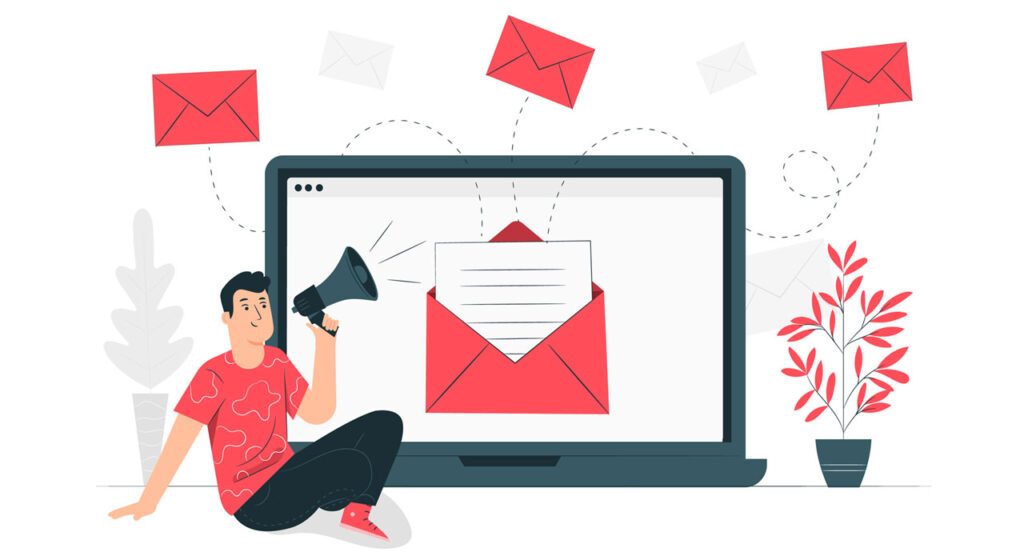
If you are one of those who always search for the zero input box, you may be wondering about the effectiveness of email newsletters, also known as “newsletters”.
Do they still make sense?
You might also ask yourself: is sending a newsletter a good idea for your business or do you become unpleasant for the target audience over time?
It turns out that not only email newsletters are still useful, but they remain one of the best strategies to develop that stronger relationship with your leads and customers.
See also
- Gastronomy and Culture: A Meeting That Transcends Tastes
- Nationalvox is honored by ALESC for its 20 years of innovation in digital marketing
- NVX 20 years: A history of innovation, partnership and success in digital
- Digital Transformation in Cuiabá Companies: Benefits and Challenges
- Social media trends for 2024: platforms that are shaping digital marketing
- The Power of Google Evaluations: How to Improve Your Business’s Reputation
- 7 content to convert to funnel fund with real estate marketing
But make sure you run it well.
To be a good marketing action, the newsletter should add value to those who are meant to: entertaining, educating and engaging. A good newsletter should be the central component of your email marketing strategy.
In this article, I analyze some of the reasons why newsletters are valuable to companies, how to do and avoid excesses, and ways to create a successful email.
Check out the following topics:
- What is a newsletter?
- The history of the newsletter
- Benefits of a newsletter
- How to create a killer strategy for newsletters?
- Beware of shipments: do not abuse the shots
- Building a strong list of subscribers
- Conclusion
What is a Newsletter?
It is an email marketing with content directed according to defined segmentation, sent periodically as a way to interact with subscribers who have already expressed interest in your business.
The newsletter can be used as a retention tool or to carry potential customers even further forward on the customer's journey.
But attention: an email marketing newsletter is different from a transactional email. The latter is an individual communication between a company and a client related to a specific action that the client has carried out. For example, request a new password or order a product from a website in case of ecommerce.
Importantly, what newsletter makes you a source of information.
When email newsletters produce quality content on a topic or area that you dominate, your company may become authority in the niche in which you operate.
If you own a medical clinic, for example, and distribute health care posts and materials, you are creating a potential newsletter on the subject, which may refer to your client's future choices.
The history of the newsletter
Unlike many people think, this story is an ancient passion. It takes us to the 1970s when a computer engineer named Ray Tomlinson sent the first email message. In 1978, the first “mass email” (for 400 recipients!) It was sent by Arpanet by Digital Equipment Corp.
Email marketing, including newsletters, began to take off in the 1990s with widespread use of the Internet and a new way for marketers to engage their current and potential customers.
With the increase in activity around email, the late 1990s and early 2000s saw the introduction of regulations such as the Data Protection Act (LGPD)) to protect consumers' privacy and ensure compliance with marketing based on permission.
Activation and deactivation requirements also help companies to ensure that their subscribers are interested in what they have to offer. Email regulations are still evolving to this day. And this is an important item: never forget to put in email, a field for lead unregistration.
Finally, the introduction of mobile devices saw a significant change in how consumers interact with email and newsletter.
According to HubSpot, 46% of emails are opened on a mobile device. The rise of smartphones, in particular, had a substantial impact on the features that make an email newsletter useful, especially in terms of design.
Benefits of a newsletter
Although the large number of emails sent has increased exponentially since Ray Tomlinson, this is still an excellent way to involve your audience. How effective is email marketing in 2021?
Take a look at some of these email marketing statistics:
- For every $1 spent, email marketing can lead to a $44 ROI.
- There are 4 billion email users in the world.
- Among small and medium-sized companies, 81% use email as their main acquisition channel, while 80% use email for retention.
- Among B2B marketers, 31% believe newsletters are the best way to nourish leads.
Email newsletters work well for all company sizes, whether B2B or B2C. Compared to other channels, such as advertising on social media or third-party media, email can also be relatively cheap to implement.
The brand perception among the target audience is undoubtedly one of the pillars of entrepreneurship, and the newsletter can also help in this sense. By creating an email shooting routine, you promote customer loyalty to earn trust and respect from your audience.
There are many email marketing tools to help manage your subscriber lists, create email templates, and launch campaigns. Here at Nvx knots We use Bulldesk, our partner for marketing campaigns.
How to create a killer strategy for newsletters?
First, your newsletters need an attractive subject line. The recipients should open their newsletter when it appears in the inbox and for this you need to use creativity, which will draw the reader's attention.
The best newsletters also offer clear call to action (CTA), sharp images and a minimalist design. This is especially important to make newsletters more readable by email on mobile devices.
The recipients should know exactly where to find the information they need, rather than looking for different buttons, graphics and font sizes.
In addition, a good newsletter should offer content that your subscribers want to read. For example, the newsletter by email from a private school may include a student highlight, while the newsletter by email from a bank focused on entrepreneurship can offer content with tips to create and do business management, ideas to undertake and credit facilities.
It all depends on who and what you want to achieve!
Beware of shipments: do not overshoot
That the newsletter is created with the main objective of bringing the reader closer to the brand, we have already seen here. But avoid abusing shipments, otherwise the effect on the public will be the opposite. Instead of bringing the lead closer to your business, you will make it disappear in a few clicks on the uncharted or spam marking.
The conclusion is one: the content offered must always be of quality and relevant.
To have good metrics, understand that responding to your client's wishes does not mean bombing him with promotions and information about the products you market.
The most converted content is the most useful one for the reader: they solve doubts, present solutions to problems, talk about new possibilities related to his interests, among others.
A good practice is to send monthly or fortnightly newsletters. Some companies with large numbers of leads and customers usually make weekly shots. But like every business that aims to succeed, use common sense And testing is never too much!
Building a strong list of subscribers
Each reader you add to your subscriber list is a new opportunity to convert a potential customer into a paying customer. After creating the newsletter itself, developing a strategy to win subscribers is the next and most important step for your strategy to be achieved.
Some tips you can use to start increasing your subscriber list today:
Create digital baits: rich content, such as e-books and white papers, is extremely useful for getting email subscribers. Develop landing pages with forms that offer these materials and ask for the email addresses of the visitors in exchange for the download.
Use image-based decoy phrases: adding attractive CTAs to blog posts will encourage visitors to sign up for your list. Use images and an action-oriented language to get the attention of blog readers.
Request email addresses when you finish buying: People who buy your products today are more likely to buy from you in the future compared to new potential customers.
Create banners pop-ups on specific pages or even on the home page, with a simple call that can be: “Sign our newsletter and stay informed of the news.”
Get your customers' email addresses to send them receipts, updates and newsletters.
Update your email subscription: If your sellers regularly reach potential customers by email, you can get more subscribers by adding a small CTA to everyone's email subscription.
Convert your followers to social media: If someone follows you on social media, there's a greater chance that they're interested in keeping up to date with your brand by email. Promote the benefits of a newsletter – as exclusive content – in some social media publications every month.
Conclusion
There are many creative ideas of newsletter for you to inspire, just search the internet. Email marketing tools usually offer specific templates, including text suggestions for content.
Feeding your blog regularly can help create great newsletters, which in turn help bring audience and reach to the site. Remember that the list of leads is fundamental to this strategy.
Just as the email did not die, on the contrary, it continues to fulfill its role in digital marketing, newsletters if well made and delivered can help in the search for customers and sales.
Oh, and don't neglect the metrics, monitoring and tracking the results. Keep an eye on email delivery fees, openings and clicks.
Did you get any doubts? Comment down.