
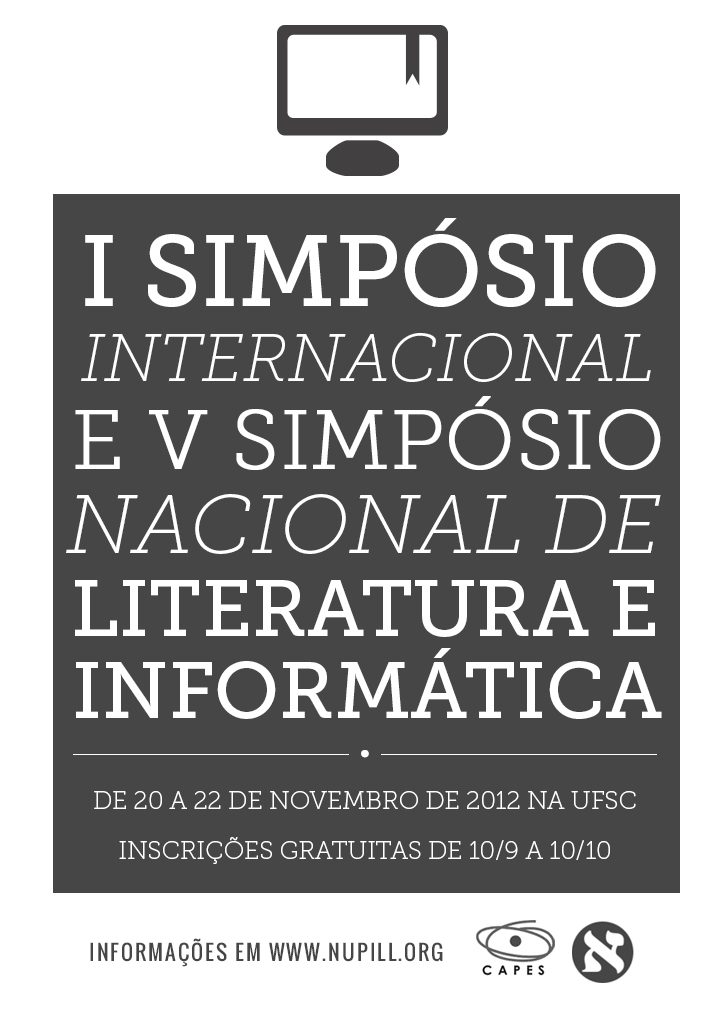
Researchers from France, Spain, Brazil and Portugal meet at UFSC to discuss the changes caused by new digital media
The impact of new technologies on the arts, literature and communication is far from being sufficiently understood. From November 20 to 22, at the Henrique Fontes Auditorium, UFSC Communication and Expression Center, scholars from various countries around the world will share their research on the relations between literature and computer science during the First International Symposium and the V National Symposium on Literature and Informatics. They will also analyze the changes in the reading and writing processes caused by the dissemination of digital media. Free registration for listeners or communicators at the symposium is open until October 10th by the website http://simposioliteraturainformatica.ufsc.br.
Promoted by the Center for Research in Computer, Literature and Linguistics (Nupill/UFSC) with support from the Coordination for Improvement of Higher Education Personnel (Capes), the event will bring together renowned researchers from Spain, France, Portugal and Brazil. Philippe Bootz (Paris 8) has already been confirmed for the opening conference; Clement Padin, a visual artist from Uruguay, who will talk about Poetic Creation and Digital Media; Lucia Santaella (PUC-SP), who will address the theme Aesthetics and Digital Media and Lucio Agra (PUC-SP), discussing the theme Digital Performance.
The challenge of scientifically understanding the role of technologies in reinventing reading and writing mobilizes students, professionals and teachers from various areas of knowledge. In addition to the Letters, researchers of design, biblioteconomy, computer science, linguistics, among other fields that have proposed the end of the demarcation between literature, science and technology are linked to the congress. “With this symposium, we intend to make clear the necessary relationship between these areas and innovation, focusing on overcoming prejudices of many decades that legitimize the watertight division of these inseparable dimensions of knowledge,” explains Nupill’s coordinator, Alckmar Luiz dos Santos, who is also coordinator of the event and professor of the Graduate Course in Literature at UFSC.
The communications presented should revolve around the various theoretical, practical and artistic implications of the relations between computer and literature, added Professor Cristiano Salles, of the organization committee. The congress will discuss the specificity of digital media, emphasizing computer processing and automated analysis of languages and literary texts. This approach includes the work done by libraries and digital literature databases; tools to support reading, teaching and learning in digital media; literary creation and arts in digital media; computer processing of literary texts and digital literary journals.
Brazil will be represented by scholars from UFSC, UEL, USP, UFMG, UFBA, UPF, Ulbra/SP, PUC/SP, UFPI, UFMF and Mackenzie Presbyterian University. From abroad, researchers from the University of Paris 8 and Sophia Antipolis – Nice University in France; from Fernando Pessoa University in Portugal, and Universidad Complutense in Madrid, Spain, will participate in the event, which is supported by the dissemination of the UFSC Secretariat of Culture.