
Some say that business (and marketing in particular) is much like war. Only on this ground, the battles are less deadly and a little more refined!
The term guerrilla marketing emphasizes this approach and reminds us that a good combative strategy is inspired by tactics of war such as surprise, speed, aggression, mobility and an unusual approach to achieve a goal and of course: defeat the enemy, in this case competition.
See also:
- Gastronomy and Culture: A Meeting That Transcends Tastes
- Nationalvox is honored by ALESC for its 20 years of innovation in digital marketing
- NVX 20 years: A history of innovation, partnership and success in digital
- Digital Transformation in Cuiabá Companies: Benefits and Challenges
- Social media trends for 2024: platforms that are shaping digital marketing
- The Power of Google Evaluations: How to Improve Your Business’s Reputation
- 7 content to convert to funnel fund with real estate marketing
- Enhance your sales with the power of WhatsApp Marketing
- The new era of email marketing: how to stand out in the inbox
But what is guerrilla marketing?
Also known as guerrilla propaganda, it appeared in 1984 when Jay Conrad LevinsonAt the time, the director of the creation of the advertising agency Leo Burnett published a book entitled “Guerrilla Marketing”.
His thought was that guerrilla marketing would be especially beneficial for small businesses, so he gave his book the secondary title “Easy and cheap strategies to make big profits with his small business.”
Suitable for large and small budgets
With its multiplier effect of economic strength and low cost, guerrilla marketing ideas have definite benefits for start-ups and small businesses, as well as for medium-sized companies, which struggle to maintain traditional marketing and advertising, often expensive.
For this reason, it is also popular among non-profit moneyless organizations that seek direct ways to leverage the consumer's portfolio without having to resort to mirable advertising campaigns.
Today, we know that large corporations can also carry out an excellent guerrilla marketing campaign. Among those I can quote as exponents of the large budget of guerrilla propaganda are: Coca-Cola, Burger King and Red Bull, among others.
Characteristics of guerrilla marketing
Because of its complexity, it's hard to define the term guerrilla marketing. However, you may recognize a guerrilla marketing campaign when you see one. All you need to do is look for certain resources.
Element of surprise: This type of marketing offers unusual interactions with potential customers. Often, guerrilla marketing tries to surprise or shock the public.
Cost-effectiveness: Most guerrilla marketing campaigns have low budgets, but they do produce great results. This feature makes guerrilla marketing resembles the Growth hacking.
Interactivity: Guerilla marketing depends on emotions and experiences and encourages the target audience to participate in a campaign.
Used in B2C: Emotions are a great driver of sales for the common consumer. In B2B (enterprises), decisions are made more carefully and completely, making guerrilla marketing less applicable in this sector.
Provocativity: As guerrilla marketing depends on emotional interaction, campaigns are often provocative and risky.
The Benefits of Guerilla Marketing
Now that you know that guerrilla marketing is an economical and efficient way to promote a business, let's examine the other advantages of this approach:
Greater brand knowledge
Guerilla marketing is about creating a business around a business. Provocative and unconventional campaigns are the perfect fuel to build brand knowledge.
Out of the way, I'm not sure.
Bold and memorable guerrilla marketing actions work as well as a unique value proposition in terms of differentiating your company from competition.
Emotional Connection to a Brand
As guerrilla marketing is good for stirring emotions, a single campaign can create a strong connection between a brand and a customer. This connection is the key point of all strong and lasting relationships with buyers.
Building partnerships
Most guerrilla marketing campaigns are complex ventures that require collaboration between various companies or organizations. Therefore, guerrilla marketing can be the perfect basis for partnership building.
Components of guerrilla marketing
To be effective, a guerrilla marketing campaign must:
- Focus on your target market – Don’t try to serve everyone. Aiming for a market segment is much more effective because it is easier to achieve, it will cost less, and because it can speak directly to your particular needs and desires. So instead of trying to sell to the athletes, focus on marathon or street runners.
- Emphasize the benefits – most companies focus on the resources of a product or service, but the benefits are the reason why people actually buy. So instead of talking about how soft the leather of a shoe is, talk about how it reduces the bubbles. Or rather than how light a car is, how to spread the amount of money that drivers will save on gasoline as a result.
- Give customers what they want – How is your product or service better than what is already in the market? Does he meet an unreached need? What exactly does that do? Be clear about what your offer does helps potential customers understand why they should buy it.
- It generates high profits – guerrilla marketers monitor profits more than sales or revenues. The goal is to get a lifetime customer who buys regularly and is willing to spend ever greater amounts on you.
Check out some popular guerrilla marketing formats and how to apply in your business:
Ambush marketing
Ambush marketing or marketing can be understood as a set of parallel advertising actions, of direct or indirect character, to an event made by non-sponsoring brands.
It is about hitchhiking in visibility, movement and consumption interest generated by large events even without sponsoring them.
The idea is to induce the public to believe that their products, services, brands and contents are approved or associated with the official organization of the event in question.
Ex: Nike and her gold sneakers at the 1996 Olympics

At the 1996 Atlanta Olympics, American sprinter Michael Johnson stood out for breaking two world records by winning the 200m and 400m races.
The ambush is there in the fact that he wore the flashy golden sneakers of Nike, and the official sponsor of the sporting event was Reebok.
To further increase Nike's visibility and decrease the competition's visibility, Johnson was the cover of Times magazine with his tennis hanging around his neck along with his two gold medals.
Furthermore, Michael Johnson's outstanding running in his home country (USA) was even better for Nike, who was very opportunist.
Secret Marketing
Also known as invisible marketing, it is an approach used to attract customer interest without raising awareness of consumers who are being subjected to a marketing approach.
This process depends heavily on the basics of viral marketing, a strategy that involves the dissemination of one good or service from one person to another. Often, the approach is rather discreet, does not seem to have a direct involvement with those who disclose the product and may even include the distribution of free samples to the target customers.
There are many examples of secret marketing in use today. A common approach is to hire the services of a respected public personality, such as an Instagram digital influencer with thousands or millions of followers.
The executioner of the strategy is then seen by the general public using the goods or services produced by the company, but without promoting the sale directly. The influencer can offer to share the product with other people in their profiles or business, and even offer testimony to the benefits derived from the use of the product.
This approach generally works based on the relationship that already exists between the influencer or artist and interested consumers. In this way, secret marketing has shown a fairly consistent ability to produce sales over time.
Environmental Marketing
Here it is important to highlight: do not confuse with green marketing. Remember, we're talking about guerrilla strategies. The term “environmental” must be understood as an external environment and means putting an engaging message or image in an unexpected place. Consequently, environmental marketing occurs totally offline.
However, this type of guerrilla marketing is not just about putting an ad somewhere unexpected. The message itself must be shocking, surprising and creative. The fashion brand, Louis Vuitton, created a perfect environmental marketing case. He put a giant installation of a suitcase in Red Square.
It involves the creative use of an external element to convey a promotional message. For example, using: stairs; elevators; pavements; roads; bathrooms; public squares, etc.
Experience Marketing
The goal of experiential marketing is to create a situation where the target audience enters a memorable situation and connects with something that symbolizes their brand. Experiential marketing campaigns aim to build a close bond between your company and its potential customers.
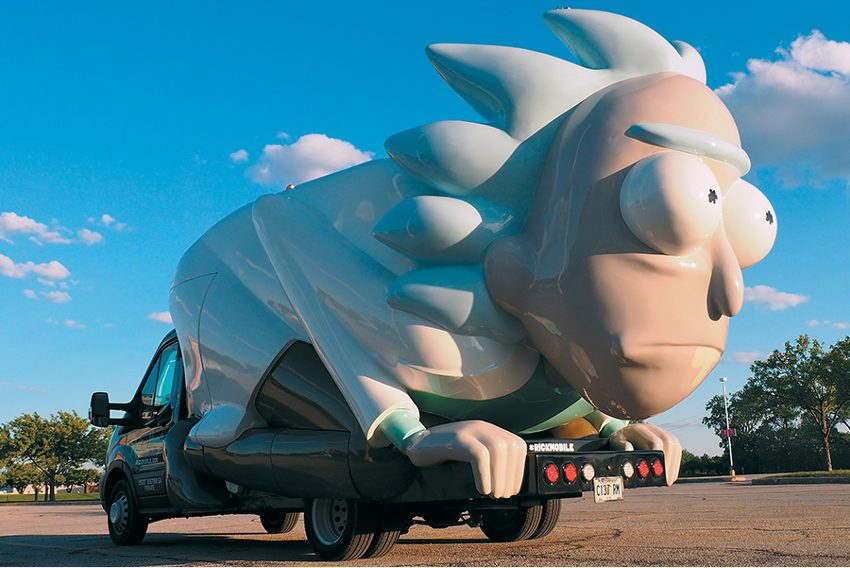
The most obvious tactic is to hold or sponsor an event, such as a convention, fair and even online events. However, you can employ a more creative approach, such as Rick and Morty's cartoon series.
The creators of the show sent a car shaped like Rick to the cities of the United States. They also organized social media support for the campaign. The action has gone viral. People followed the vehicle all over the country to take a picture with him and buy goods.
Conclusion
Guerilla marketing works better when associated with other strategies. You can use with email marketing campaigns, landing pages with digital baits for lead capture, campaigns for whatsapp, Instagram Reels, Tik Tok, etc.
It is a marketing format that not only requires a lot of creativity, but also an action plan. So get to know your audience, set goals, analyze your environment, execute your plan and last but not least: Measure the results!
Given the continued growth of social platforms where brands connect directly with consumers and the growing expectation that the public will be surprised, delighted and entertained with products and services, the Commission will be able to assess the impact of the new technology on the market. guerrilla marketing will continue to bloom in 2021.